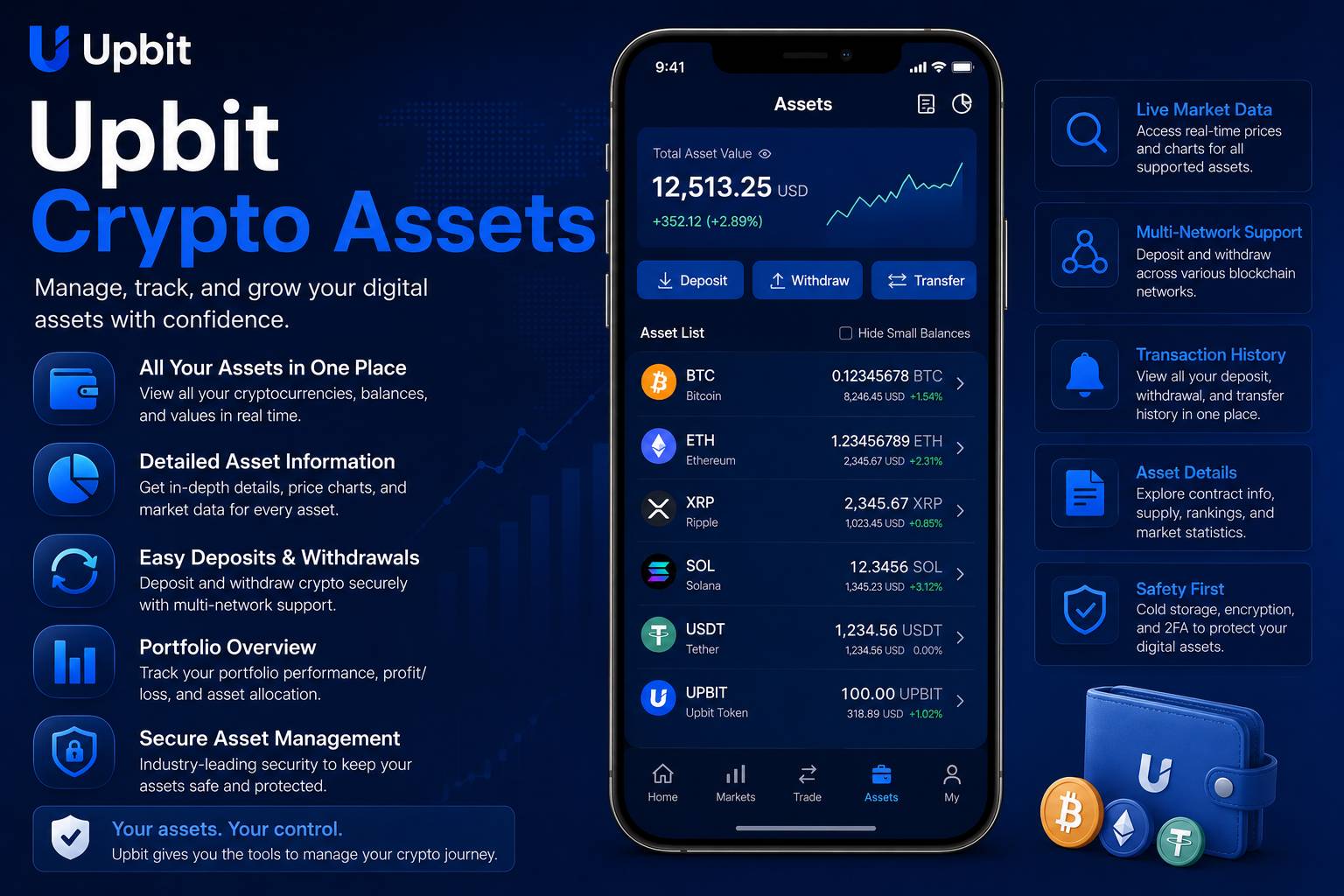
Understanding Crypto Assets Inside a Platform Account
Crypto asset management is one of the main reasons users explore Upbit and other digital asset platforms. A user may want to check balances, review supported assets, monitor price movement, inspect transaction history, deposit funds, withdraw assets or understand how a portfolio is organized. These tasks may look simple inside a mobile app, but each one deserves careful attention.
A crypto asset page is not only a list of coins or tokens. It can represent account value, transaction records, available actions, network information, warnings and portfolio structure. Users should understand what they are seeing before taking action. A balance number may look straightforward, but it can be affected by pending deposits, open orders, locked funds, network delays, withdrawal limits or asset-specific rules.
Different assets can behave differently. Some assets may move on different networks. Some may require a memo, tag or destination identifier. Some may have different withdrawal conditions. Some may have high volatility or limited liquidity. A user should never assume that every asset works the same way. Responsible asset management begins with reading asset-specific information carefully.
This guide explains crypto asset management from a practical user perspective. It is not a recommendation to buy, sell or hold any asset. It is an educational overview for users who want to understand how to review asset sections, avoid common mistakes and build safer portfolio habits.
Balance Review
Users should understand total value, available balance, pending activity, open orders and asset-specific account details.
Network Awareness
Crypto transfers can depend on the correct network, address, memo, tag and destination requirements.
Transaction History
Records help users verify deposits, withdrawals, trades, account activity and any unfamiliar movement.
Asset Pages and What Users Usually See
An asset page usually provides several layers of information. Users may see the asset name, symbol, balance, estimated value, available amount, recent movement, transaction buttons and history. Some pages may also show deposit and withdrawal options, market links, notices, network choices or risk warnings. Each part has a purpose, and users should avoid tapping through these sections too quickly.
The total balance may show the full amount associated with an asset, but the available balance may be different. Funds can be locked in open orders, pending transfers or other account actions. A user who sees a total amount should not assume the full amount is immediately usable. Checking available balance and account history helps reduce confusion.
Estimated value can also change quickly. Crypto prices move, and the value displayed in a portfolio may update based on market conditions. Users should understand that estimated value is not a fixed guarantee. It is a current calculation based on available price information. During volatility, the value may change rapidly.
Asset pages may also include shortcuts to trade, deposit or withdraw. These actions should be treated differently. Viewing information is low-risk. Initiating a transfer or placing an order is higher-risk. Users should separate observation from action and read all details before confirming anything.
Portfolio Review and Asset Organization
A portfolio review is more than checking whether the total value is higher or lower than before. A responsible user reviews what assets are held, how much of each asset is available, whether any positions are inactive, whether recent transactions are recognized and whether the account structure still matches personal intentions. Portfolio awareness helps users avoid losing track of account activity.
Users should consider organizing assets mentally into categories. Some assets may be long-term holdings. Some may be used for transfers. Some may be small remaining balances from past activity. Some may be watched but not actively used. Understanding why an asset is present can help users manage the account more thoughtfully.
Small balances deserve attention too. Users may ignore them because they seem unimportant, but small balances can create confusion in portfolio totals or transaction history. A careful user knows what each balance represents. If an asset appears unexpectedly, the user should investigate before taking further action.
Portfolio review also helps users notice unusual activity. If a balance changes unexpectedly, the user should check transaction history, open orders, deposits, withdrawals and security settings. Unfamiliar activity should not be ignored. Early review can help users respond faster if something is wrong.
Deposits and Withdrawal Awareness
Deposits and withdrawals are among the most sensitive asset actions. A crypto transfer may require the correct asset, network, address and sometimes memo or tag information. Entering the wrong details can cause serious loss. Users should review transfer instructions slowly and avoid acting while distracted.
Deposit screens may show a wallet address, network selection and warnings. Users should confirm that the sending platform supports the same network and asset. A mismatch can create problems. Withdrawal screens may require even more attention because the user is sending assets away from the account.
Users should never copy addresses from untrusted sources. Clipboard malware can replace copied addresses. After pasting an address, users should check the beginning and end of the address carefully. For assets that require a memo or tag, the destination instructions should be reviewed exactly.
Transfer checklist
- Confirm the exact asset.
- Check the selected network.
- Verify the destination address.
- Review memo or tag requirements.
- Check amount and fees.
- Confirm only when fully certain.
Why Network Selection Matters
Network selection is one of the most important details in crypto asset management. Some assets may exist on more than one network, while others may require a specific network for deposits or withdrawals. A user must make sure the sending and receiving sides match. If they do not match, the transfer may fail, be delayed or become unrecoverable.
New users sometimes assume that an asset symbol is enough. For example, they may see the same asset name on two platforms and assume transfers are compatible. This is not always safe. The network matters. The receiving platform may support only certain networks. The sending platform may offer multiple choices. Users should read both sides carefully before initiating a transfer.
Memo, tag or destination identifier requirements add another layer. Some assets or platforms require extra information in addition to the address. Omitting this information can cause delays or loss of credit. Users should never ignore a memo or tag warning. They should follow the destination instructions exactly.
Network fees and confirmation times can also vary. A transfer may be fast or slow depending on the network and current conditions. Users should not panic immediately if a transaction is pending, but they should know where to check transaction status and account history. Reading platform notices can help users understand expected timing.
Transaction History and Account Records
Transaction history is one of the most useful tools for asset management. It allows users to review deposits, withdrawals, trades, transfers, fees and account activity. Users should not rely only on memory. A written or platform-based record helps confirm what happened and when.
A transaction history page may include timestamps, asset names, amounts, status labels, fees and transaction identifiers. Status labels are important. A transaction may be pending, completed, failed, canceled or under review depending on platform rules and network conditions. Users should read the status carefully before assuming the action is complete.
Account records can also help users notice unfamiliar activity. If a withdrawal, trade or deposit appears that the user does not recognize, the account should be reviewed immediately. Security settings, email access, active sessions and device history may need attention. Unfamiliar records should never be ignored.
Users may also need records for personal tracking, reporting or tax-related preparation depending on their location and situation. This guide does not provide tax advice, but users should understand that platform history may be important for their own recordkeeping. Saving relevant records in a secure manner can help with future review.
Supported Assets and User Responsibility
Supported asset lists can change over time. A platform may add, remove, pause or restrict certain assets depending on technical, legal or operational reasons. Users should check current platform information before assuming that an asset is available for trading, deposit or withdrawal. Old information may no longer apply.
Users should also understand the difference between being able to view an asset and being able to use every feature related to that asset. An asset may be visible in a market list, but certain actions may depend on account status, region, network support or temporary platform conditions. Reading notices and asset-specific information is important.
Asset responsibility includes understanding risk. Digital assets can be volatile. Prices may change sharply. Some assets may have lower liquidity or higher uncertainty. A platform interface can display information, but it does not guarantee safety or future value. Users are responsible for research, decision-making and risk management.
Users should avoid holding or transferring assets they do not understand. Before taking action, they should know what the asset is, why they are using it, what network applies, what risks exist and how the account will be affected. Careful asset management begins with basic understanding.
Asset Security and Storage Habits
Asset management is closely connected to security. A user may have a clear portfolio, but weak security can still put the account at risk. Password protection, authentication, email security, device safety and phishing awareness all protect assets indirectly. Users should treat asset security as part of daily account use.
Withdrawal actions require extra caution. Attackers often try to trick users into sending assets voluntarily. A fake investment message, fake support request, copied address, urgent warning or social engineering attempt can cause a user to approve a transfer. Once a transfer is complete, recovery may be difficult or impossible.
Users should protect addresses, avoid sharing screenshots with sensitive details and be cautious when discussing account balances publicly. Revealing too much information can make someone a target. Crypto privacy is not only about hiding from the platform. It is also about avoiding unnecessary exposure to strangers.
Strong asset security depends on routine. Users should review settings, check transaction history, confirm alerts and avoid approving actions under pressure. A calm user is more likely to notice mistakes before they become irreversible.
Building Better Crypto Asset Habits
Better asset habits begin with regular review. Users should check balances, open orders, recent transactions, pending transfers and security notices periodically. This does not mean watching the app constantly. It means having a routine that keeps the user aware of account status without reacting emotionally to every market movement.
Users should separate observation from action. Looking at an asset page is observation. Reviewing value is observation. Checking history is observation. Depositing, withdrawing or trading is action. Action requires a higher level of attention. This separation helps users avoid accidental decisions.
Users should also keep learning. Asset rules, network requirements, fees and platform features can change. A responsible user reads notices and confirms details before each important action. Memory is not enough because crypto systems can be technical and updates can affect the process.
A careful asset routine gives users more control over their experience. It does not remove market risk, but it reduces avoidable mistakes. When users understand balances, networks, transfer requirements, transaction records and security habits, they can manage the crypto asset environment with greater clarity and patience.
Important Notice
This page is an independent educational crypto assets guide. It is not operated by or officially affiliated with Upbit. The content is provided for general information only and should not be considered financial, investment, legal, tax or account-specific advice. Digital assets involve risk, and users are responsible for their own decisions and account activity.