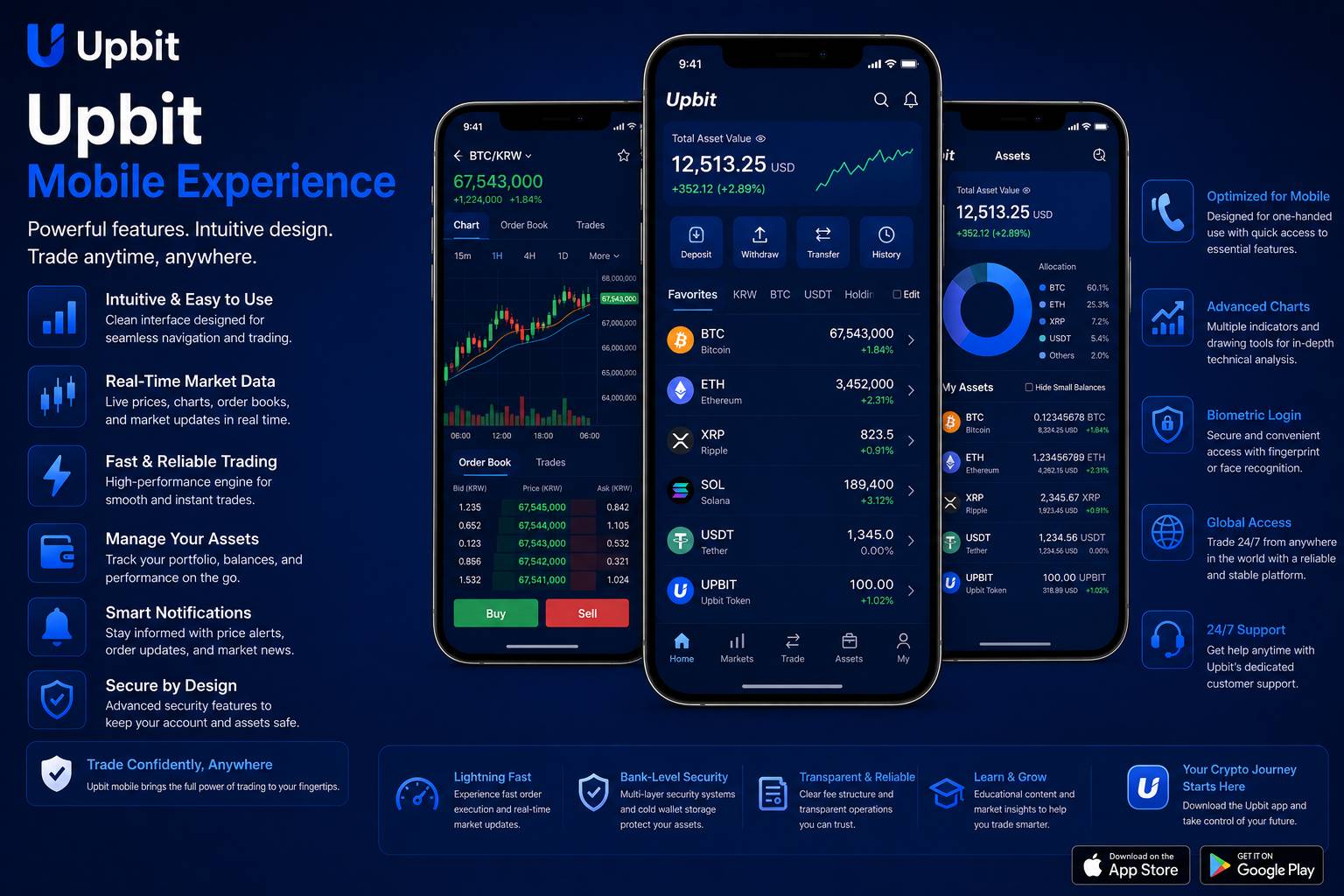
Why Mobile Experience Matters in Crypto
The mobile experience is one of the most important parts of how users understand Upbit and other digital asset platforms. Many users do not begin their crypto journey on a large desktop screen. They begin on a phone, where market prices, account balances, login prompts, asset pages and security settings are all placed into a compact interface. Because of that, a mobile crypto app must be approached with patience and awareness.
A good mobile experience is not only about speed. Speed is useful, but clarity matters more. Users should be able to understand where they are inside the app, what action they are about to take, which asset is selected, which account section is open and whether a screen is informational or action-based. The difference between viewing a balance and confirming a transfer is significant. The difference between checking a market chart and placing an order is also significant.
Mobile access gives users convenience, but convenience can create risk. A person may check an account while traveling, sitting in a cafe, walking outdoors or responding to a notification. These moments are often distracting. When a crypto account is accessed on a phone, the user should remember that every tap matters. A wrong tap, a rushed confirmation or a misunderstood alert can lead to mistakes.
This guide explains how users can think about mobile app structure, navigation, security and daily habits. It is not an official app manual and does not provide account-specific instructions. It is written as a practical educational page for users who want a clearer mobile-first understanding.
Small-Screen Clarity
Mobile screens should help users identify account areas, market sections, trading tools and security controls without confusion.
Faster Access
App access can be convenient, but users should avoid acting quickly without reviewing all important details first.
Security Awareness
Mobile devices require strong screen locks, trusted app sources, safe networks and careful login habits.
Mobile Navigation and User Orientation
Mobile navigation should help users build a clear mental map of the app. A user should know where to find the dashboard, market list, trading area, asset section, account settings and security tools. If the user has to guess where important features are located, mistakes become more likely. A structured mobile interface reduces confusion by grouping related actions together.
New users should spend time exploring the app without taking action. They can open different tabs, read labels, check where settings are located and understand how screens connect. This exploration period is useful because it separates learning from action. The user learns the environment before placing orders, changing settings or moving assets.
Icons and labels matter on a small screen. A button may look simple, but users should know what it means before tapping. A wallet icon, market icon, trade icon or settings icon can lead to different types of pages. If the user is unsure, they should pause and read the surrounding text. A mobile app should be used deliberately, not by random tapping.
Users should also notice when a screen changes from viewing mode to confirmation mode. Viewing a chart or balance is different from confirming an order or transfer. Confirmation screens should be read fully. The smaller the screen, the more important careful review becomes.
Market Viewing on a Phone
Market viewing is one of the most common mobile activities. Users may open the app to check price movement, compare assets, review trading pairs or follow a watchlist. A phone makes this easy, but it also makes it easy to react emotionally. A quick price movement on a small screen can feel more urgent than it really is.
Users should remember that mobile charts show limited space. A chart may not provide enough context at first glance. Switching timeframes, reading labels and reviewing additional information can help, but users should avoid making serious decisions based only on a quick mobile glance. A chart is information, not certainty.
Watchlists can help mobile users stay organized. Instead of scrolling through many markets, users can follow selected assets. This reduces noise, but it should not create pressure. A watchlist is for observation. It should not become a trigger for constant trading or emotional decision-making.
Notifications can also influence market viewing. A price alert may bring the user back into the app, but an alert should not automatically lead to action. The user should review the market calmly, confirm the asset and understand the broader context before making any decision.
Account Access From Mobile Devices
Mobile account access should be handled with strong security habits. A phone used for crypto access should have a secure lock screen, updated software and trusted apps. Users should avoid installing apps from unknown sources or granting unnecessary permissions to random tools. The security of the device directly affects account safety.
Users should also protect the email account connected to the crypto account. Many login alerts, password reset messages and security confirmations may arrive by email. If the email account is weak, the crypto account can become more vulnerable. Email security and app security should be considered together.
Public Wi-Fi should be avoided for sensitive actions. A user may check general market information on the go, but account changes, withdrawals, password updates and other high-risk actions should happen through a trusted connection.
Mobile safety checklist
- Use a strong phone lock.
- Keep the device updated.
- Install apps only from trusted sources.
- Avoid public Wi-Fi for sensitive actions.
- Do not approve unexpected login prompts.
- Protect the connected email account.
Trading Features on Smaller Screens
Trading features can be harder to review on a smaller screen because several details must fit into a compact space. A trading page may include asset pair selection, price fields, quantity fields, order type choices, order book data, chart movement, balance information and confirmation controls. Users must be careful not to overlook any of these details.
Before placing an order from a phone, users should confirm the selected pair, direction, order type, price, amount and estimated total. They should also review fee information where available. Mobile convenience should not replace full review. A rushed order on a phone can create the same consequences as a rushed order on desktop.
Users should be careful with touch input. It is easy to mistap a number, select the wrong field or overlook a decimal point. Before confirming any order, the user should read the confirmation screen slowly. If anything looks wrong or unclear, the action should be canceled and reviewed again.
Mobile trading should also be avoided while distracted. Users should not place orders while walking, driving, multitasking or responding to emotional market movement. A focused environment helps reduce mistakes.
Asset Review and Portfolio Checks on Mobile
Asset pages are often checked on mobile because users want quick access to balances and transaction history. This convenience is useful, but users should understand what the numbers mean. Total value, available balance, locked funds, pending transfers and recent activity may all affect the account view.
A user should not rely only on the total portfolio value. They should review individual assets, transaction history and pending actions. If an asset appears unexpectedly or a balance changes without a clear reason, the user should investigate. Mobile access makes quick checks easy, but deeper review is still necessary when something looks unusual.
Deposits and withdrawals require special attention on mobile. Address copying, network selection, memo or tag entry and amount confirmation can be more error-prone on a small screen. Users should verify every detail before confirming a transfer. A small screen does not reduce the importance of accuracy.
Users should also be mindful of privacy. Checking balances in public can expose information to people nearby. A private setting is better for sensitive account review.
Notifications, Alerts and Mobile Discipline
Notifications are useful when they inform users about account activity, price movement or important notices. However, too many notifications can create pressure and noise. Users should configure notifications intentionally. Security alerts may be important. Market alerts may be useful. Random noise may encourage unnecessary app checking.
An alert should be treated as a reason to review, not a command to act. If a price alert appears, the user should open the app calmly and check context. If a login alert appears unexpectedly, the user should not ignore it. Different alerts require different responses. Learning the difference is part of mobile discipline.
Users should avoid notification-driven trading. When alerts repeatedly pull someone into the app, they may start reacting to every movement. This can lead to emotional decisions and overtrading. A responsible user chooses when to act rather than letting every alert control attention.
Building a Better Mobile Crypto Routine
A better mobile routine begins with a clear purpose. Before opening the app, the user can ask: am I checking a balance, reviewing a market, reading a notice, adjusting security settings or preparing for an action? Knowing the purpose helps prevent accidental decisions. Without purpose, users may drift from observation into action without thinking.
Users should also set personal rules for sensitive activity. For example, they may decide not to withdraw assets while traveling, not to trade while distracted and not to change security settings on public Wi-Fi. These rules create boundaries that protect the user from rushed behavior.
Regular review is useful, but constant checking is not always helpful. Crypto markets move often, and mobile access can become distracting. A user who checks too frequently may become emotionally reactive. A balanced routine allows users to stay informed without letting the app control every moment.
The best mobile experience combines convenience with caution. A phone can make account access easier, market review faster and portfolio checks more convenient. But the user must still read carefully, verify details and protect the device. A mobile-first crypto user should be patient, security-aware and deliberate with every important tap.
Important Notice
This page is an independent educational mobile experience guide. It is not operated by or officially affiliated with Upbit. The content is provided for general information only and should not be considered financial, investment, legal, tax or account-specific advice. Users are responsible for their own account security and platform activity.