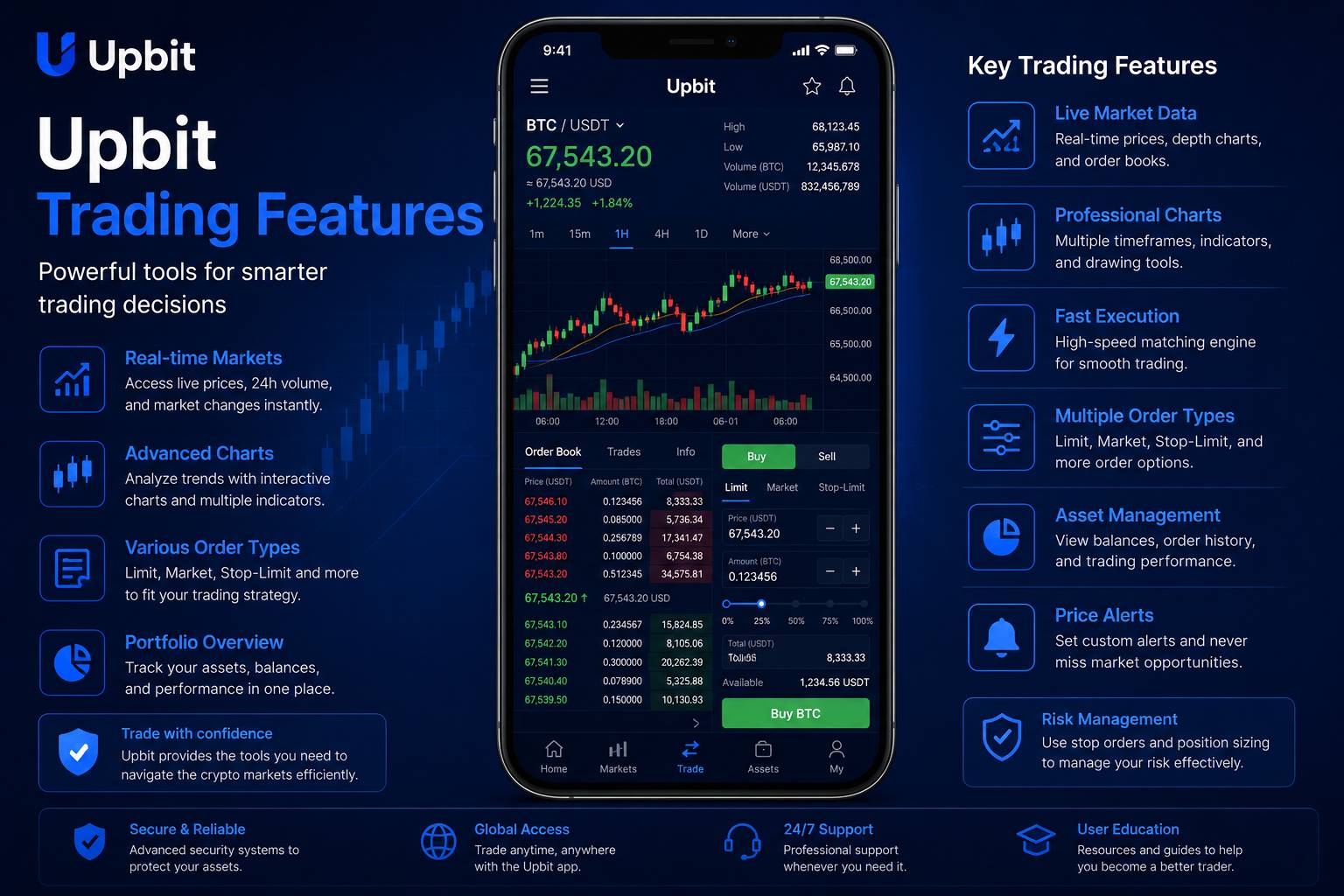
Understanding Trading Features Before Taking Action
Trading features inside a crypto platform can look exciting, especially when prices are moving quickly and market pages are filled with live information. Users who search for Upbit trading features often want to understand how the trading environment is organized before using it seriously. This is a smart approach. A trading interface may appear simple, but each part has a specific purpose, and careless use can lead to mistakes.
A trading page may include current prices, charts, order books, recent trades, asset pair selection, order entry fields, balance information, fee estimates and trading history. New users may see all of this at once and feel overwhelmed. Experienced users may understand the layout but still need to check details carefully. The goal of this guide is to explain trading feature areas in plain English so users can approach them with more awareness.
It is important to understand that trading tools are not recommendations. A chart does not tell users what they must do. An order book does not remove risk. A price movement does not guarantee direction. A platform can provide information and execution tools, but users are responsible for their own decisions. This page focuses on feature understanding, not financial prediction.
Responsible trading begins before any order is placed. Users should know what asset they are viewing, what pair is selected, what price field means, what quantity they are entering, what type of order they are choosing and what account balance will be affected. If any part is unclear, the user should pause and learn before continuing.
Market Views
Market views help users compare assets, observe movement and understand which trading pairs are available.
Chart Areas
Charts help users visualize price movement across different periods, but they should not be treated as certainty.
Order Panels
Order panels require careful review because price, quantity, order type and confirmation details all matter.
Market Pages and Asset Pair Selection
Market pages are often the first trading-related area users explore. A market page may show a list of assets, price movement, percentage changes, volume and available trading pairs. These pages help users compare different assets and decide what they want to study further. However, users should avoid assuming that the most active asset is automatically the best choice. Activity can reflect interest, volatility, news or short-term speculation.
Asset pair selection is important because it defines what the user is viewing or trading. A pair shows the relationship between two assets or between an asset and a quoted currency. Selecting the wrong pair can lead to confusion. Users should always check the pair name before reviewing a chart or entering an order. If a user thinks they are looking at one market but is actually viewing another, any decision based on that screen may be flawed.
Market lists can also be filtered or sorted in different ways. Users may sort by price movement, volume, favorites or asset category. Sorting is useful, but it can also shape attention. For example, a list sorted by strongest gainers may encourage users to focus only on assets that already moved sharply. A careful user understands that sorting is only a viewing tool, not a strategy.
Favorites or watchlists can help users organize the assets they want to monitor. Instead of scrolling through many markets, users can create a smaller list. This can reduce distraction. However, a watchlist should not become a source of impulsive action. It is simply a way to observe selected assets more efficiently.
Reading Price Charts With Patience
Price charts are one of the most visible trading features. They show how an asset has moved over a selected period. Charts may include candles, lines, indicators, volume bars and different timeframes. A chart can help users understand movement, but it cannot predict the future with certainty. Users should read charts as information, not as a promise.
Timeframe selection changes the meaning of a chart. A one-minute chart may show short-term movement that looks dramatic, while a daily chart may show a broader pattern. New users often react too strongly to short timeframes because every movement looks important. A careful user compares timeframes and asks whether the movement is meaningful or simply normal volatility.
Candlestick charts can show open, high, low and close values for a period. They are useful, but they require practice. A single candle should not be overinterpreted. Users should look for context, volume and broader market conditions. Even then, chart reading remains uncertain. No chart pattern removes risk.
Indicators may appear helpful, but they can also confuse users. Moving averages, volume indicators and other tools are only interpretations of market data. They may help some users organize information, but they do not guarantee outcomes. Beginners should avoid adding too many indicators at once. A crowded chart can create the illusion of knowledge while making the screen harder to understand.
Order Books and Recent Trades
The order book is a trading feature that displays available buy and sell interest at different prices. It can help users see market depth and understand where orders are currently placed. However, the order book changes quickly. What appears available at one moment may change by the time the user acts. Users should not treat the order book as fixed.
Recent trades show transactions that have already occurred. This can help users observe current activity, but it does not prove what will happen next. A stream of recent buys or sells may look persuasive, but markets can reverse quickly. Users should use recent trade information as context rather than as a trigger for emotional action.
Together, the order book and recent trades provide a window into activity. They are useful for understanding liquidity and short-term movement, but they require calm interpretation. Beginners should study these sections without rushing to act.
Before placing an order
- Confirm the correct trading pair.
- Review the selected order type.
- Check price and quantity fields.
- Understand estimated total cost.
- Review fees or related charges.
- Confirm only when fully certain.
Understanding Order Types
Order types are one of the most important trading feature areas. Different order types can behave differently, and users should understand them before using them. A market order is generally designed to execute quickly at available market prices. It may be convenient, but the final execution price can vary, especially in fast-moving or less liquid markets. A user who values price control should understand this risk.
A limit order allows the user to set a specific price condition. This can provide more control, but it may not execute if the market does not reach the selected price. Some users misunderstand this and assume that placing an order means it will always complete. A limit order can remain open, partially fill or not fill depending on market conditions and platform rules.
Other order types may include additional conditions depending on platform availability. Users should read each option carefully. Names can sound simple, but the actual behavior matters. If an order type involves triggers, stop conditions or advanced settings, the user should understand what event activates the order and what happens afterward.
Before confirming any order, users should review the order preview if available. They should check the pair, direction, order type, price, amount, estimated value and any fee-related information. Confirmation screens exist for a reason. They give users a final chance to catch mistakes. A careful trader never treats confirmation as a formality.
Balance, Available Funds and Trading Limits
Trading features are connected to account balances. Users should understand the difference between total balance, available balance and funds locked in open orders. A user may see an asset in the account but not be able to use the full amount if part of it is already committed to another action. This can confuse beginners who do not review open orders or pending activity.
Available funds are the portion that can be used for a new action. Before placing an order, the user should confirm that the available amount matches expectations. If it does not, the user should check open orders, pending deposits, withdrawals or other account activity. Acting without understanding balance status can lead to errors.
Some accounts may also have limits based on verification, region, account status or platform rules. Users should review any visible limits before assuming that every function is available. Limits are not always problems; they may be part of compliance, security or account protection. The important point is to understand them before planning account activity.
Trading History and Order Review
Trading history helps users review past activity. It may show completed orders, open orders, canceled orders, average price, quantity, fees and timestamps. This information is important for accountability. Users should not rely only on memory. Reviewing history helps users understand what they actually did, not what they think they did.
Open orders deserve special attention. A user may place a limit order and forget about it. If the market later reaches the selected price, the order may execute unexpectedly from the user’s point of view. Regularly reviewing open orders can prevent surprises. If an order no longer matches the user’s intention, the user should consider whether it should remain active.
Canceled orders can also provide useful information. They show attempts that did not execute or were removed. Reviewing canceled orders can help users understand their own behavior. Were they changing prices too often? Were they reacting emotionally? Were they placing orders without a clear plan? History can teach users about habits.
Trading records may also be useful for personal tracking, tax preparation or portfolio review depending on the user’s situation. Users should keep their own records where necessary and understand that platform history may not replace personal responsibility. Careful recordkeeping is part of mature account management.
Risk Awareness While Using Trading Tools
Trading tools can make action easy, but they do not reduce market risk by themselves. Digital assets can move quickly. Liquidity can change. News can affect price. User mistakes can happen. A responsible user should never place an order simply because the interface makes it convenient. Every action should be connected to understanding, preparation and risk tolerance.
One key risk is emotional trading. When prices rise quickly, users may fear missing out. When prices fall quickly, users may panic. A mobile trading interface can intensify these emotions because it is always available. Users should be aware of their emotional state before acting. If a decision feels rushed, it may be better to step away.
Another risk is overtrading. Frequent small trades may feel productive, but fees, spreads and mistakes can add up. Users should understand costs before trading often. They should also consider whether each action has a clear reason. Trading without a plan can become a habit driven by screen movement rather than careful thought.
Users should also think about position size. Placing too much value into one action can increase stress and risk. Even if a user understands the interface, they should still consider whether the amount is appropriate for their personal situation. Platform features do not know the user’s full financial condition. The user must decide responsibly.
Mobile Trading and Screen Discipline
Mobile trading requires screen discipline. A phone screen can hide details that would be more visible on a larger monitor. Users may scroll, tap quickly or miss small labels. Before confirming any action on mobile, users should slow down and review the full screen. If something is cut off, hidden or unclear, they should not proceed until they understand it.
Notifications can also affect trading behavior. A price alert may be useful, but it can also create urgency. Users should decide in advance how they will respond to alerts. An alert should invite review, not automatic action. If a user opens the app because of a notification, they should still read the market calmly and check all details.
Mobile environments can also be distracting. Users may trade while walking, commuting, talking or multitasking. This increases the chance of errors. Crypto trading actions should be handled in a focused setting. If a user cannot give full attention to the screen, they should avoid placing orders or changing important settings.
Building a Better Trading Feature Routine
A good trading feature routine begins with observation. Users can start by reviewing market pages, reading charts, checking asset pairs and watching how order books move. They do not need to place orders to learn. Observation helps users understand the interface without adding financial pressure. Beginners especially benefit from spending time in observation mode.
The next step is structured review. Before any action, the user should ask several questions. What asset is selected? What pair is selected? What is the current market condition? What order type is being used? What price and quantity are entered? What fees or costs may apply? What happens if the order executes? What happens if it does not? These questions create a pause between intention and action.
Users should also review outcomes. After an order is placed, they should check whether it is open, partially filled, completed or canceled. They should review history and understand how the account balance changed. This habit helps users learn from real activity and avoid confusion later.
A mature trading routine is calm, repeatable and careful. It does not depend on excitement. It does not rely on guesses. It does not ignore warnings. Trading features can be useful tools, but they require responsible users. The better a user understands the interface, the more carefully they can manage their own actions.
Important Notice
This page is an independent educational guide to trading feature areas. It is not operated by or officially affiliated with Upbit. The content does not provide financial, investment, legal or tax advice. Digital assets involve risk, and every user is responsible for understanding platform tools and making personal decisions carefully.